Implementing container image signing ensures deployment integrity by verifying the authenticity of images in your CI/CD pipelines, preventing unauthorized changes.
## Understanding Container Image Signing: The Basics
When it comes to deploying container images, many organizations assume that a successful CI/CD pipeline guarantees a trustworthy deployment. However, here's the truth: passing tests and completing scans in the pipeline doesn’t inherently validate that the image in production matches the original artifact intended for deployment. This gap can potentially open the door to significant trust issues.
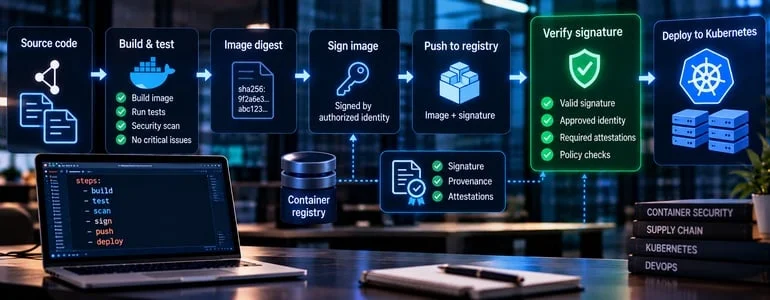
Effective container image signing emerges as a vital measure to address this ambiguity. At its core, image signing links cryptographic proof directly to the specific artifact digest. This mechanism enables deployment systems to confirm both the identity of the signer and their authorization, ensuring a level of accountability that basic CI/CD processes don’t provide.
### The Role of Kubernetes Admission
One of the most critical junctures in the deployment process is the Kubernetes admission stage. This phase serves as a gatekeeper, capable of rejecting unsigned or improperly signed images before they can do any damage in a live environment. As you work with automated Kubernetes deployments, ephemeral CI runners, and enhanced software supply chain controls, it becomes clear how essential this step is for maintaining the integrity of your deployment pipeline.
### Why Traditional Security Checks Fall Short
Despite being equipped with trusted registries and rigorous vulnerability scanning, organizations often overlook the fact that these systems don’t actually ensure that the running image is the intended artifact. An image may have passed through all checks only to be replaced or tampered with by an unauthorized user. Implementing container image signing is crucial—it adds a new layer of trust by verifying the provenance of each image before deployment.
For those of you in the DevOps space, the shift in focus should be clear: it’s less about verifying whether the pipeline created an image and more about whether your deployment environment can authenticate and track its origins accurately. The potential for inconsistencies highlights why integrating signing into the delivery architecture—not as an afterthought, but as a fundamental step—can make a significant difference in ensuring safe deployments.
In a world where automation and speed are increasingly paramount, understanding and implementing container image signing could be the difference between a seamless rollout and a disastrous security incident. So if you're streamlining your CI/CD workflow or tightening your security protocols, consider how you will incorporate image signing into your strategy—it’s more than a mere checkbox; it’s an essential practice for modern software delivery.### Connecting the Dots in Container Signing
The significance of container image signing extends beyond simply attaching a cryptographic signature to an artifact. It fundamentally redefines how we ensure the integrity and identity of software as it moves through the stages of development and deployment. Signing establishes a clear line of trust, but its effectiveness increases exponentially when integrated with the broader software delivery pipeline.
What's critical here is that each element of the deployment process must contribute to an overarching security model. A signature might authenticate an image, but it doesn’t ensure the artifact is free of vulnerabilities. That's where a measured approach to security comes into play. Artifacts can travel not just from one CI/CD process to another, but also through potential breaches if trust boundaries aren’t established early enough.
A strong deployment architecture will go beyond simple signing and incorporate artifacts like Software Bill of Materials (SBOMs), provenance data, and detailed attestations. This layered approach helps answer essential questions about not just the identity of the signer, but also the conditions under which the artifact was built and verified. It’s imperative to remember that a signature can exist on an image that contains vulnerabilities, while an unsigned artifact might be completely secure. Therefore, you can’t rely solely on signing as a blanket assurance of safety.
### Beyond Simple Signing: The Software Supply Chain Perspective
As we look to the future of secure software development, the focus must shift from merely signing containers to implementing a holistic software supply chain security strategy. Each segment—from source control to CI processes, SBOM generation, and the eventual deployment in Kubernetes—plays a pivotal role in ensuring the trustworthiness of software.
It’s not enough to trust an image just because it has a valid signature or resides in a reputable registry. The deployment system has to develop a nuanced understanding of the entire build and delivery pipeline, weighing multiple data points before making a trust decision. Kubernetes admission plays a key role here by acting as a checkpoint, enforcing policies that demand proof of compliance with the organization’s standards.
This comprehensive security paradigm isn’t just about preventing bad deployments. It’s about creating an environment where every piece of software meets a stringent definition of trust before entering production. For DevOps teams keen on enhancing their security posture, this evolution towards a cohesive and evidence-driven approach is where the real work begins. The journey from container signing to a fully functional software supply chain security model is not just advisable—it’s necessary for robust security.
Discussion
Sign in to join the discussion.