A study reveals that Docker Swarm's resource reservations can conflict with infrastructure metrics, complicating autoscaling decisions.
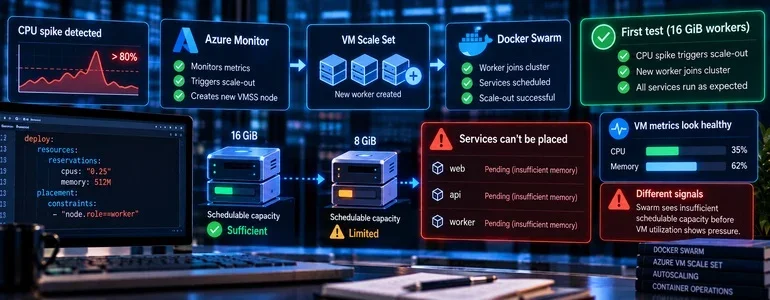
In managing cloud environments, the interplay between autoscaling mechanisms and container scheduling can reveal unforeseen challenges. A recent series of tests centered on Azure Virtual Machine Scale Sets (VMSS) and Docker Swarm illustrated that even when a CPU-triggered scale-out seems successful, other factors can complicate overall capacity management. Understanding these complexities not only helps in optimizing automated scaling but also ensures that cloud resources are used efficiently, which is paramount in today’s increasingly resource-constrained environments.
Unpacking the Scale-Out Process
The initial tests confirmed that autoscaling worked as intended when CPU utilization crossed certain thresholds. By employing Azure Monitor, our design effectively relied on metrics such as CPU and memory usage to inform scaling actions. This allowed for the dynamic addition of new VM instances to the Docker Swarm cluster. The interactions observed not only illustrated a functional relationship between metrics and system responses but also raised questions about the adequacy of current metrics in reflecting true system health. What may seem like a healthy system based purely on CPU load might mask other underlying issues.
Revisiting Worker Configurations
A pivotal moment arose during a subsequent test aimed at assessing the operational impacts of reducing the size of Docker Swarm workers from 16 GiB to 8 GiB of memory. Despite maintaining existing service reservations, the resulting scheduling behavior diverged dramatically from expectations. Many services could not be accommodated within the cluster, which led to confusion. In this instance, the infrastructure autoscaler was unable to recognize the limitations imposed by Docker Swarm's scheduling constraints. Services that were deemed ready to run were left pending, revealing significant flaws in the assumptions surrounding resource availability.
This disconnection brought to light critical questions regarding autoscaling policies and their required correlations with container orchestration constraints. The breakdown stemmed from a fundamental misunderstanding: resource reservations inform anticipated capacity for scheduling but don't reflect actual runtime consumption. Without aligning these two perspectives, organizations may face significant performance bottlenecks.
Understanding Resource Reservations
In Docker Swarm, when memory reservations are declared for tasks, it's meant as a safeguard. This ensures that a specific amount of capacity remains available for the placement of individual tasks. Yet, this mechanism does not guarantee that the reserved memory is actively utilized at runtime. When nodes appear underutilized from a VM perspective, the scheduler may misinterpret their status as full based on unmet reservations. This can lead to underutilization—what you might see as available capacity can actually be constrained by how reservations are set.
This complexity underscores a pressing need for better coordination between the orchestration layer and the infrastructure layer. Azure Monitor might show satisfactory host performance, giving users a false sense of security. In contrast, Swarm's scheduler is focused more on committed resources which can differ widely from what is actually accessible for immediate tasks. This leads to a system that’s operationally inefficient, impeding scaling efforts and resource management.
Future-proofing Autoscaling Strategies
This experience prompted a serious reevaluation of how we validate autoscaling mechanisms. A singular focus on CPU scale-out success doesn’t provide a complete picture. To that end, I’ve initiated validation alongside alternative considerations:
- Can every required task be scheduled at the minimum worker count?
- What are the implications of changing worker sizes on overall schedulable capacity?
- Which specific metrics most effectively trigger scaling actions?
- Are these metrics responsive enough to avoid leaving tasks pending?
This multidimensional approach facilitates a more nuanced understanding of the dynamics at play. It’s about aligning autoscaling policies intelligently with the behaviors of the scheduler. Without this alignment, infrastructure can miss the mark by scaling up prematurely or unnecessarily, based on metrics that don’t capture real-time needs. Such a strategic misalignment could lead to wasted resources and operational costs that undermine the efficiency of the entire system.
The Path Forward
The results of these tests make one point clear: effective autoscaling signals can emerge not just from conventional metrics that indicate system load but from comprehending the boundaries set by scheduling policies. Therefore, if you're working in this space, consider adopting a more holistic approach that merges resource scheduling with autoscale monitoring. This will help in constructing a resilient cloud architecture that can both respond to demands and manage resources effectively.
Ultimately, if the infrastructure lacks visibility into the pressures faced by the scheduler, simply adding more autoscaling rules based on host metrics won’t resolve the fundamental communication gap. Thinking critically about these elements is crucial for operational efficiency, ensuring that the system can proactively respond to the scheduler’s demands while managing resources effectively.
Implications of Our Findings
These findings prompt a significant reevaluation of how organizations might think about scaling in cloud environments. As companies increasingly adopt microservices architecture with container orchestration, the communication and coordination challenges between autoscaling and task scheduling will only grow. If the teams behind these architectures don’t stay ahead of the curve, the pitfalls surrounding resource underutilization or overprovisioning could set back their operational efficiency.
What this means for you is clear: an upgrade to your current autoscaling strategies isn't optional but a necessary step if you’re looking to achieve a truly integrated and efficient cloud operation. The implications extend beyond current settings; they'll shape the structures and protocols for future deployments.
Discussion
Sign in to join the discussion.