Explore the critical link between service health and data freshness in cloud-native applications, emphasizing the need for comprehensive monitoring strategies.
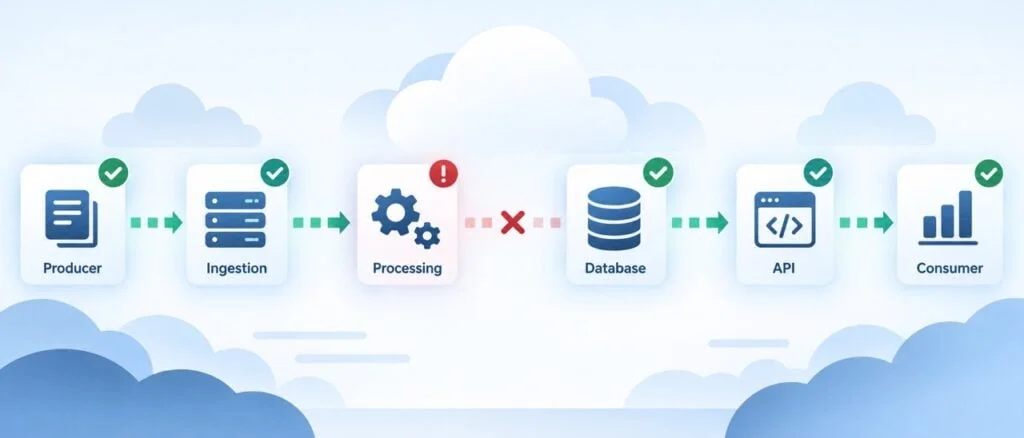
In the realm of cloud-native applications, the traditional metrics for gauging service health have become increasingly inadequate. While a service might be operational—successfully handling requests and accessible from an infrastructure standpoint—this doesn’t mean the data it delivers is up-to-date. Users often find themselves in situations where the system returns stale information, raising the question of what it truly means for an application to be “healthy.”
Understanding the Disparity Between Service and Data Health
The disconnect between service availability and data accuracy can lead to significant user frustrations. In data-rich applications where constant updates are expected, a service can appear to be functioning correctly even when its data delivery has stagnated. This distinction is vital: a service can be technically sound, yet the information it provides may be outdated.
Unpacking the Green Health Check Illusion
Let’s dissect a common data lifecycle: Producer → Ingestion → Processing → Database → API → Consumer. If the producer halts sending updates, downstream components might still report as operational. The ingestion layer can stay up, the database remains reachable, and the API may continue returning the last available data point. Hence, every stage can indicate that things are running smoothly, while in reality, the entire data flow is stalled.
Data Freshness as a Health Metric
For applications that depend on real-time data, freshness needs to be integrated into the overall health metrics. Understanding the expected cadence of data updates and comparing it with the timing of the last successful update can provide deeper insights into service health. For example, if a system typically receives updates every 30 seconds, a slight delay might not be alarming. However, if multiple expected updates are missed, that’s a condition that should trigger an alert.
The threshold for what constitutes “current” data should be clearly defined, recognizing that different workflows—like real-time streaming versus periodic batch processing—have distinct definitions of staleness.
Adapting to Intermediate States
One common misstep is categorizing every delay in data freshness as a full system outage. If data sources start lagging, merely restarting services that are otherwise healthy won’t resolve underlying issues. Instead, recognizing intermediate statuses—like degraded or stale states—enables a more nuanced response. A dashboard could still display the last recorded value while marking it as outdated, allowing for differentiated handling of information based on its recency.
Enhancing Visibility Through Data Flow Monitoring
Cloud-native frameworks offer extensive observability into various components. However, monitoring must extend beyond CPU usage or request latency to encompass the flow of data through the system. Key signals to track include:
- Last successful update: When did the most recent data arrive?
- Data age: How current is the latest information in circulation?
- Expected frequency: What is the standard timing for updates?
- Processing lag: Is data taking longer to pass through the pipeline than anticipated?
- Duration in degraded state: Are we observing a temporary delay or is it an ongoing issue?
By analyzing these metrics collectively, engineers can efficiently focus their investigations on prior stages in the data pipeline when inconsistencies arise, rather than incorrectly targeting a seemingly healthy application.
Managing Alert Noise in Freshness Monitoring
Once data freshness is quantifiable, the risk of overwhelming alert systems arises. Not every minor delay warrants immediate action—often, upstream processes experience temporary hiccups. Therefore, establishing a balance between alert frequency and severity is critical. A transient delay may move an application into a degraded state without necessitating urgent alerts, but persistent issues across multiple update cycles can escalate to a stale condition that should trigger appropriate responses.
The ultimate aim is to curate alerts that deliver actionable insights rather than contributing to alert fatigue among engineering teams.
Embedding Freshness in Application Design
Ideally, considerations for data freshness should be integral during the design phase, rather than a patchwork response following a failure. Data providers can enhance their offerings by incorporating timestamps or sequence identifiers, which help consumers determine whether information is being updated in real-time. Processing layers should broadcast their latest activities, and APIs must ensure users have clear insights into data currency.
This becomes even more important as system architectures increase in complexity. When multiple services mediate between data producers and consumers, it’s entirely possible for some components to indicate they are “healthy” while data flow has actually halted upstream.
Rethinking the Definition of Health
While existing health checks serve as useful indicators—summarizing process liveness, service readiness, and infrastructure performance—cloud-native applications need to pose an additional question: Is the information still fresh enough to be used reliably? Extending the conventional health model to incorporate data freshness presents a more accurate picture of application reliability. A strong principle to adopt is that a healthy service should possess the ability to detect when its data becomes compromised.
In conclusion, cloud-native systems must evolve health check protocols to account for the interplay between data freshness and service availability, leading to a more reliable user experience and accurate operational insights.
Discussion
Sign in to join the discussion.