NVIDIA's Open AI Initiative: Building the Future of AI Infrastructure
Published
Jul 28, 2026
Desk
AI & ML
Views
411
NVIDIA is investing $4 million to enhance open AI infrastructure, emphasizing the need for real GPU access to accelerate AI innovation and deployment.
NVIDIA's Commitment to Open AI Infrastructure
There’s a growing buzz around NVIDIA as it steps deeper into the realm of open AI. This isn’t merely a public relations play; the company is rolling up its sleeves and investing real resources into building an open ecosystem that could redefine how AI models are developed and deployed.
When discussing what we mean by “open AI,” the focus often remains on whether you can access model weights or modify training datasets. But these aspects merely scratch the surface. A truly open AI framework requires an infrastructure beyond just model availability. It hinges on compute power, effective scheduling, robust storage solutions, observability for tracking performance, and security measures—all intertwined with accessibility.
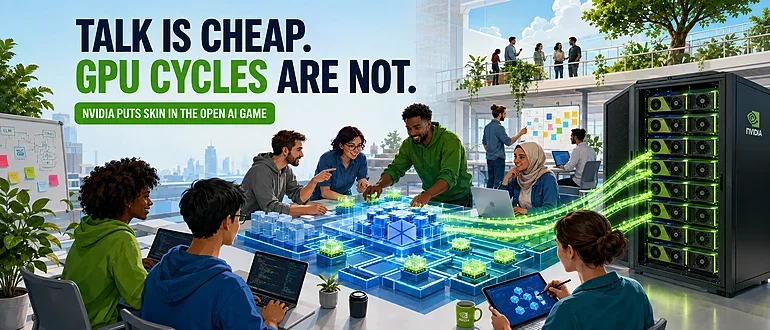
What’s compelling about NVIDIA’s recent moves is the tangible commitment to support open AI infrastructure. Erin Boyd, a senior director at NVIDIA and member of the CNCF Governing Board, recently emphasized that the future of AI development rests in collaborative community efforts. NVIDIA is not just participating; the company has made a substantial pledge, committing $4 million over three years to help various projects run tests on real GPUs, not just simulated environments.
And that's significant. In the AI domain, compute resources are the lifeblood. When researchers and developers don’t have access to adequate GPU cycles, the innovation cycle slows down. NVIDIA’s investment signifies an understanding that access to actual hardware is vital for fostering advancement in AI. While code contributions and community engagement are crucial, nothing beats the necessity of having a robust infrastructure that can effectively test and validate software in real-world scenarios.
Kubernetes: The New Operating Layer for AI
Kubernetes, long hailed as the standard for orchestrating applications in cloud environments, is increasingly emerging as the backbone of AI operations. The cloud-native ecosystem has prepared for such a development, even if the notion didn’t initially center around AI workloads. This orchestration framework now faces similar challenges seen across distributed systems, specifically tailored for AI's requirements.
Organizations are discovering that while training models is one facet, the full lifecycle of AI includes fine-tuning models, serving inference, and mastering resource allocation—issues that fall squarely into the realm of distributed systems. The statistics are revealing: while most container users have adopted Kubernetes, a mere 7% of organizations deploy models daily, indicating a disconnect between building AI applications and integrating them into consistent production processes.
A significant factor driving this gap is how Kubernetes historically managed GPU resources. Initially, GPUs were treated as static, unchanging assets. That approach doesn't hold up in modern scenarios where workloads can fluctuate wildly, leading to wasted compute power, idle resources, and inefficient usage. As AI becomes more embedded in everyday business operations, adapting Kubernetes to manage dynamic GPU allocation is no longer optional; it's essential.
NVIDIA’s acknowledgment of this challenge is noteworthy. Their efforts are directed at developing tools to make GPU usage in Kubernetes as flexible and manageable as traditional CPU resources. This could address many synchronization and resource contention problems developers face today. The real question is whether the industry can unite in creating these capabilities collaboratively or if we'll see a patchwork of vendor-specific solutions.
By supporting an open, community-driven approach, NVIDIA is betting on the latter. Building a unified, vendor-neutral ecosystem for AI operations could unlock significant efficiencies and innovation opportunities.
Rethinking Open AI: Beyond Weight Sharing
The narrative around open AI often stops at the availability of model weights, but it glosses over a much broader picture. NVIDIA has made it clear that they've no intention of giving up the keys to their chip designs; CUDA and NVLink are too vital. This reinforces a critical point: true openness isn't about relinquishing every competitive edge; it's about the thoughtful unification of capabilities that fosters innovation across the industry.
To build a genuinely open AI ecosystem, we must focus on the shared components that the community can build upon. This includes not just models, but also the essential infrastructure such as scheduling systems, observability tools, and APIs. What’s often overlooked is how these elements interconnect to create a versatile environment where users can operate multiple models across different clouds or accelerators without getting bogged down by the complexities of proprietary barriers.
NVIDIA's recent actions signal a shift. Their commitment to engaging with platforms like the Cloud Native Computing Foundation (CNCF) underlines a strategic pivot: investing in open, community-governed infrastructure that holds the potential to amplify AI adoption. There's no conflict inherent in wanting to drive community benefits while also seizing market opportunities. The real question isn’t whether NVIDIA will profit; it’s whether their efforts will benefit a larger community.
As NVIDIA contributes code, engineering expertise, and essential GPU resources, they set a precedent for others in the AI sector. This kind of contribution is what we need to elevate the scale of community cooperation. From hyperscalers to model developers, the industry players must realize that enhancing open infrastructure goes beyond surface-level participation. It's about dedicating tangible resources—commitment that extends past product promotion into genuine development.
Here's the takeaway: if everyone in this ecosystem follows NVIDIA's lead, we may witness an accelerated transformation toward an open AI framework. But let's not be naïve: discussions around openness should translate into actionable contributions. GPU cycles might not be cheap, but they are crucial for real advancements. This industry needs to move past mere rhetoric and embrace a spirit of true collaboration—only then can we build the robust infrastructure that open AI demands.
Discussion
Sign in to join the discussion.