Understanding Kubernetes Limitations: Ensuring Application Health Beyond Deployment Success
Published
Jul 30, 2026
Desk
AI & ML
Views
912
Kubernetes deployment success doesn't guarantee application health; teams must monitor business logic and transaction integrity to avoid hidden failures.
A Green Kubernetes Deployment Doesn't Guarantee Application Health
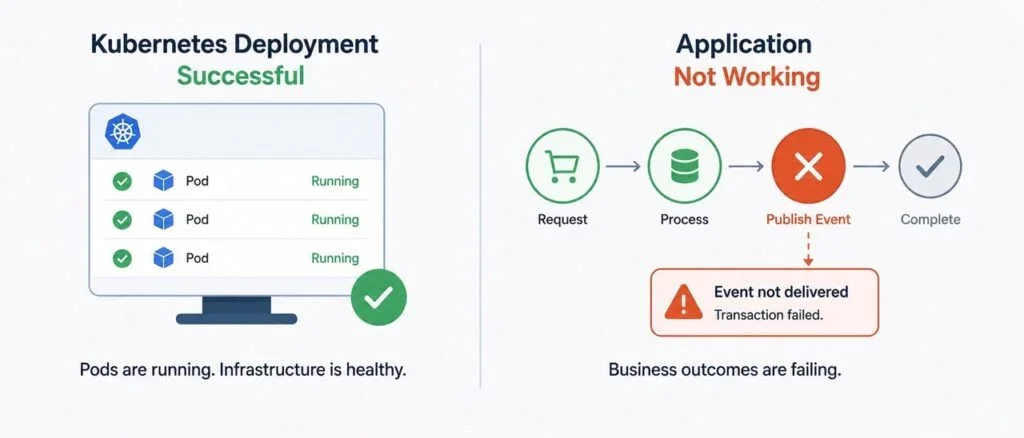
Kubernetes has become synonymous with successful deployments in modern cloud-native environments. Yet, many teams fall into the trap of equating a "green light" from their Kubernetes dashboard with a fully operational application. This is where the disconnect lies: just because a deployment is technically sound doesn’t mean the application is functioning as intended.
After executing a deployment, teams often breathe a sigh of relief when they see that kubectl rollout status reports a successful rollout status, and that all pods are marked as running and ready. For many, this moment signifies the end of the road for that release process. But this perception can be dangerously misleading.
What happens when a customer transaction fails despite all system indicators pointing to success? Kubernetes won’t alert you unless a container crashes, and the readiness endpoint might continue returning HTTP 200, misleading you into believing everything is functioning normally. This façade of health can mask serious flaws within the application, leading to increased risk of production incidents.
Kubernetes excels at maintaining infrastructure stability. It can confirm that the correct image is running and that the required replicas are in place. However, it lacks insight into the application's business logic or transaction outcomes. The deployment success confirmed by Kubernetes only validates one aspect: that the infrastructure has transitioned without disruption—it doesn't account for whether the application continues to deliver value.
The Limits of Kubernetes Readiness
Let’s examine a typical readiness probe configuration, often as simple as this:
```yaml
readinessProbe:
httpGet:
path: /health
port: 8080
initialDelaySeconds: 10
periodSeconds: 5
```
While such a setup ensures that the pod is responsive, it does not guarantee the application can perform its core functions, like accessing its database or communicating with dependent services. Kubernetes is designed to assess whether a pod is alive and able to accept traffic, but this readiness does not speak to the accuracy or integrity of the transactions it processes.
The expectation that a readiness probe can validate complex service interactions is where teams often go wrong. It’s important to adjust expectations: readiness probes should simply answer, “Is this pod safe to receive traffic?” If the bar is set too high, you risk triggering a cascade of failures. Monitoring should confirm overall application health, not just the uptime of each component.
A Deployment Can Succeed While Transaction Paths Fail
Consider a payment-processing application. It might successfully receive requests, validate them, and return responses while underlying issues disrupt crucial downstream skills, like sending payment confirmations to the correct Kafka topic. A release could pass every readiness check, and yet a simple transactional failure silently cause widespread disruption.
Kubernetes sees that the pods are running; the monitoring metrics may remain within acceptable thresholds. But for the customer, a transaction can appear incomplete, leading to frustration and lost revenue.
Moreover, as different conditions escalate, issues might remain undetected until there’s significant traffic through the new version. If monitoring kicks in only after a rollout is complete, teams can miss critical signs of failure. By the time alerts trigger, they often cast suspicion elsewhere, lengthening the time it takes to resolve the issue and unnecessary stress for developers trying to identify the root cause.
Rethinking Validation Strategies
It’s clear that relying solely on Kubernetes readiness signals is insufficient. By incorporating explicit application validation, teams can better ensure a successful roll-out. This could involve deploying the new version, waiting for readiness, running targeted application-level checks, and comparing these metrics against the previous version before deciding on promotion or rollback.
One practical step is to conduct a synthetic transaction after confirming readiness. For instance, validating the entire payment process with a controlled test ensures that the new version of a payment service is functioning correctly.
For teams working on cloud-native applications, establishing a more comprehensive deployment validation process will pay dividends. This shift will lead to fewer production issues and a more graceful scaling of technology solutions amidst ongoing development.
In conclusion, the deployment metrics provided by Kubernetes should be seen as helpful indicators but not definitive proof of an application's operational health. The responsibility lies with teams to dig deeper, ensuring that what happens behind the green indicator actually delivers real-world success.
Understanding Release Safety Beyond the Surface
Improving the safety of software releases is a multi-step process, and each enhancement plays a role in mitigating risks. However, let's face it: no validation system is foolproof. An unusual customer setup, lingering memory leaks, or a newly discovered failure mode can escape even the most rigorous checks.
What's critical here isn't the illusion of absolute certainty. The real aim is to identify known issues before they reach your users or catch the attention of your on-call engineers in the middle of a crisis. When deploying applications on platforms like Kubernetes, the technology can indeed indicate whether workloads have achieved their intended state, but that’s just one side of the equation.
Kubernetes: Performance Indicators vs. Release Efficacy
The challenge remains: determining if the release itself has actually fulfilled its intended objectives. A green light from Kubernetes might signal success in deployment, yet it doesn't automatically ensure application health. If you're working in this space, the takeaway is clear: a simple status check isn't enough. You'll need to dig deeper to connect those dots, ensuring that what’s been deployed not only works as expected but is also free from major issues that users could encounter later.
Ultimately, vigilance around these processes means you'll spend less time firefighting and more time innovating. It's essential to refine the balance between confidence in the deployment process and the understanding of its complexities. So, while the systems are improving, remember: it's not about achieving infallibility—it's about mastering the art of catching failures before they become problems.
Discussion
Sign in to join the discussion.