Container runtime security is essential for Kubernetes, yet teams often neglect critical areas. This analysis highlights key vulnerabilities and proactive measures.
Understanding the Importance of Container Runtime Security
As Kubernetes grows in popularity across various industries, securing container runtime environments must take center stage. Many discussions prioritize pre-deployment measures such as image scanning and Dockerfile hardening. While these practices are vital, they can overlook the significant security challenges that emerge once containers are deployed and running in production.
For instance, a recent discovery by SUSE researchers revealed three vulnerabilities in runC, allowing attackers to escape containers and gain root access on host systems. This incident underscores the pressing need for teams to transition their focus from theory to effective runtime security practices in Kubernetes, particularly in a landscape where the attack surface expands rapidly alongside container adoption.
Essential Aspects of Container Runtime Security
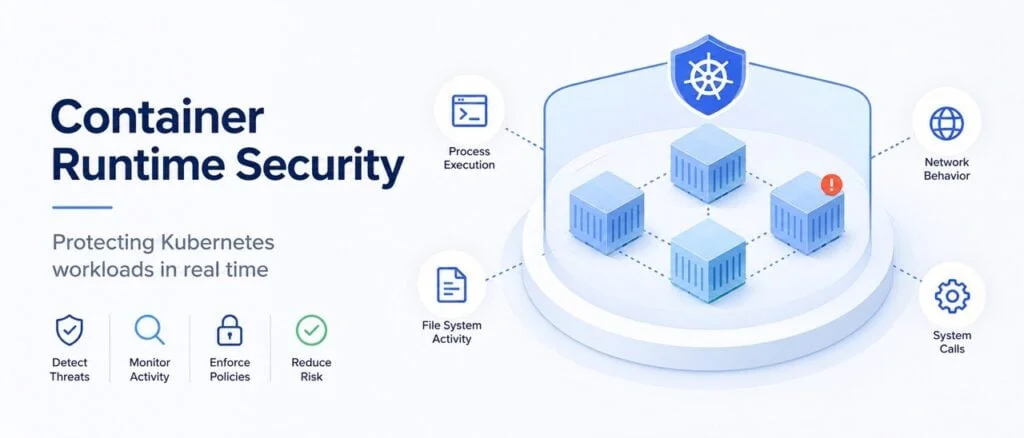
Effective container runtime security involves various tools, policies, and practices that monitor and protect containers during operation. Key factors include:
- Detecting unexpected binaries and scripts that spawn within containers
- Monitoring for unauthorized writes to read-only paths
- Overseeing network communications, both outbound and lateral
- Tracking system calls for anomalies
Kubernetes complicates these tasks since pods can launch and shut down in a matter of seconds. This rapid lifecycle, combined with the complexity of microservice architectures, makes manual monitoring impractical and highlights the necessity for automated dynamism in security monitoring.
Common Security Oversights in Runtime
Overreliance on Root Containers
Developers often opt for the convenience of running containers as root, which poses significant risks during production. This safety net can easily become a vulnerability path for an attacker who exploits the container's root access to gain control of the host system.
To counter this, it’s imperative to implement policies that enforce user context switching by employing specifications such as runAsUser and runAsNonRoot. Opting for minimal or distroless base images can enhance security and should be complemented by stricter Kubernetes Pod Security Standards to prohibit root operations.
Challenges with RBAC and Network Policies
Role-Based Access Control (RBAC) is often established with overly permissive settings that allow broad communication between pods. These configurations may seem practical initially but can escalate network vulnerabilities, significantly increasing the risk exposure.
To remedy this, teams should adopt a default-deny policy for all network traffic within namespaces, ensuring that communications are explicitly allowed. Regular audits and visualizations of RBAC permissions can also help maintain better control over access privileges.
Neglecting Real-Time Threat Detection
A common pitfall is the focus on build-time vulnerability scanning, neglecting the need for runtime monitoring. This oversight makes deployments vulnerable to threats like cryptominers, reverse shells, and data exfiltration, often remaining undetected for long periods.
Investing in kernel-level monitoring tools that operate with minimal overhead is essential. Such tools enable teams to identify unusual child processes, suspicious writes to critical directories, and anomalous outbound connections, all of which can signal a breach.
Configuration Drift and Its Risks
Regardless of the security measures taken at deployment, containers can drift in configuration post-deployment. Variables such as environment settings, binary modifications, and user inputs can lead to vulnerabilities that attackers can exploit after breaching the container environment.
To mitigate configuration drift, implementing read-only root filesystems is critical; writeable volumes should only be available when necessary. Additionally, employing drift detection tools alerts teams when a container diverges from its expected state.
Exploiting the Runtime Layer
The runtime layer itself has been identified as a target for attacks, with methods like symlink creation that bypass protective bind-mounts. Attackers may also manipulate mounts to bypass security barriers prior to the activation of protective measures, complicating response efforts.
Ensuring correctly configured runtime settings can mitigate risks, preventing unauthorized memory access or privilege escalation that could give attackers entry to sensitive areas of the host filesystem.
Building a Strong Runtime Security Posture
Establishing rigorous pod security standards is non-negotiable, ensuring that profiles restrict potentially dangerous practices like allowing privileged containers or root access. The deployment of real-time monitoring should be prioritized to track unexpected processes and changes in filesystem activity.
Implementing least-privilege network policies is also advisable. Limiting ingress and egress traffic per namespace and ensuring communications are only allowed when necessary between pods can significantly enhance security.
Continuous scanning is essential, rather than limiting detection to build time. Monitoring and auditing logs should be ongoing practices to stay ahead of potential security threats.
Conclusion: Moving Beyond Deployment Time Security
Container runtime security serves as the crucial final barrier protecting against breaches. Organizations need to maintain a vigilant stance with strong build-time controls while ensuring ongoing visibility into runtime activities. Embracing a proactive, ongoing security strategy across multi-cloud and multi-cluster environments is not an option but a necessity to manage evolving threats effectively.
Discussion
Sign in to join the discussion.