Observability in enterprise environments extends beyond cloud-native systems, requiring tailored approaches to meet diverse operational needs.
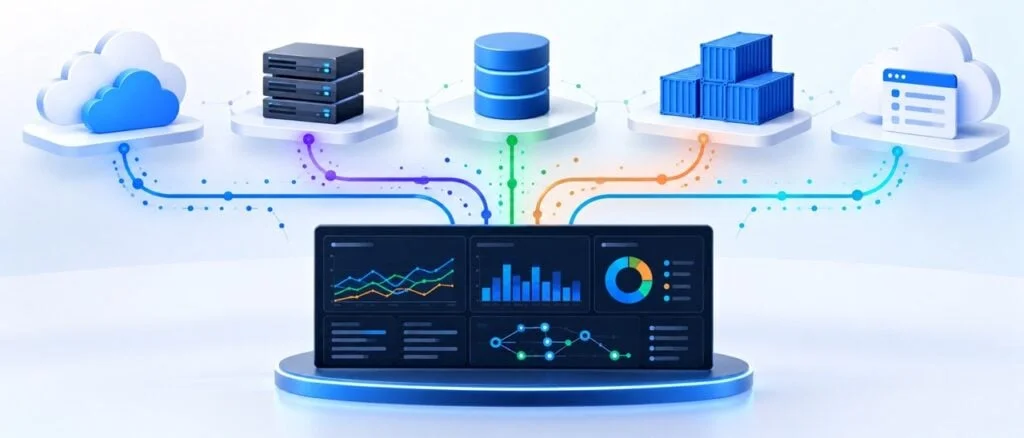
Observability discussions often center around cloud-native systems, with heavy emphasis on Kubernetes, microservices, OpenTelemetry, and distributed tracing. However, the reality for enterprise teams encompasses a much broader spectrum of systems and operational challenges. It's essential to recognize that not all teams are developing or managing microservices-based applications. Some are tasked with overseeing infrastructure, databases, platform services, governance, or applications outside their direct control. The requirements for observability will differ based on the systems in play, the associated risks, and their architecture.
The Enterprise Complexity
Many enterprise cloud environments are a blend of architectural models. An organization might leverage a mix of virtual machines, managed cloud services, databases, SaaS applications, and containerized workloads. This illustrates a vital distinction: merely operating on cloud platforms doesn’t automatically qualify workloads as cloud-native. Cloud-native implies architectural practices aimed at dynamic, automated, and evolving environments.
This differentiation is significant because the monitoring and analysis strategies teams implement must align with how their systems are crafted, their operational environment, and the team managing them. Therefore, while cloud-native observability is a pivotal aspect, it constitutes just one element of a more extensive observability framework.
Designing an observability strategy not only needs to correlate with the systems in place, but it should also match the capabilities and skills of the team implementing it. From my experience collaborating with enterprise teams, practical factors often shape the route to observability just as much as the infrastructure specifics.
There's a spectrum of how much telemetry monitoring and integration various teams can oversee. While some teams can manage collectors and telemetry pipelines, others may rely on integrated collection features that require minimal specialized setup and maintenance. Here lies a gap in the prevailing dialogues around observability. Although contemporary instrumentation frameworks and cloud-native observability practices provide valuable functionalities, they don’t uniformly address every system or organizational model.
Visibility Tailored to Systems
It's important to realize that enterprise observability doesn’t necessitate identical levels of scrutiny across all systems. Many systems have pre-established conditions for monitoring and actions to be taken in response. For instance, a database team might only require an alert once CPU usage hits a certain threshold. Conversely, infrastructure teams may need immediate alerts if a host becomes unresponsive, wherein traditional metrics, health checks, dashboards, and alerts could suffice.
However, in environments marked by higher degrees of distribution, dynamism, or complexity, relying on predefined conditions may not be adequate. In such scenarios, teams often need to synthesize metrics, logs, and traces, track dependencies, and analyze unanticipated behaviors during incidents. Here, cloud-native observability practices shine particularly well.
Using a one-size-fits-all approach to observability can sidestep situations where established metrics and alerts are sufficient to meet operational needs. Therefore, the visibility required should align with the system at hand and the specific inquiries the team must address.
Defining Observability Standards
A more effective way to assess observability is through the lens of the decisions it empowers teams to make. Can they pinpoint important changes, ascertain the affected systems, identify ownership, and determine subsequent actions? These outcomes remain fundamental, irrespective of whether the insights are derived from distributed tracing, core database metrics, audit logs, service health notifications, or supported integrations.
Signals need to streamline the transition from detection to action, furnishing enough context to prevent miscommunication about responsibilities early in an incident. The right signals provide clarity regarding changes, allowing teams to evaluate the effects and decide whether investigation, remediation, or continued monitoring is necessary.
While cloud-native systems have introduced novel operational challenges and insights for comprehending complex applications, they do not encompass the entirety of enterprise observability. The industry dialogue must recognize the varying systems, team dynamics, and operational limits present within enterprises.
Ultimately, modern observability should be evaluated based on its effectiveness in empowering teams to understand and manage their systems, rather than simply aligning with the most widely discussed models in the tech ecosystem.
Discussion
Sign in to join the discussion.