Configuring Effective Liveness and Readiness Probes in Kubernetes for Node.js Applications
Published
Sep 25, 2026
Desk
AI & ML
Views
1,301
A proper setup of liveness and readiness probes in Kubernetes is vital for Node.js apps to avoid unnecessary restarts and maintain operational stability.
Understanding Kubernetes Liveness and Readiness Probes
Understanding Kubernetes Liveness and Readiness Probes
A seemingly minor oversight in Kubernetes configuration can lead to significant operational headaches. In a recent incident involving a Node.js worker that interfaces with Redis, a missing utility caused a cascade of unnecessary container restarts, demonstrating the importance of correct probe configuration in cloud-native environments. This situation serves as a cautionary tale for those managing Kubernetes deployments.
The problem began with a liveness probe dependent on the `pgrep` command to check for the running status of the worker. However, the slim Node.js runtime image lacked this essential executable, causing Kubernetes to assume the worker was failing continuously. As a result, the kubelet restarted the worker repeatedly, landing it in a frustrating `CrashLoopBackOff` state, despite the worker itself operating correctly. This scenario raises important questions about how we design and implement health checks in a distributed system where dependencies and configurations matter greatly.
### The Importance of Probe Configuration
This situation highlights a critical point: just because you can see a process doesn’t mean it’s functioning correctly. The `pgrep` command merely checks for the existence of a process; it doesn’t assess whether the worker is effectively processing tasks or maintaining a connection to Redis. In cloud environments, the complexity of interdependent services means that a surface-level check can provide a false sense of security.
Think about it: a container can show signs of life but still fail to deliver expected functionality. This generally leads to inefficient resource usage and potential service outages—issues that can spiral out during peak loads or critical operations. As Kubernetes adoption grows across industries, ensuring these probes are well-thought-out has become increasingly vital.
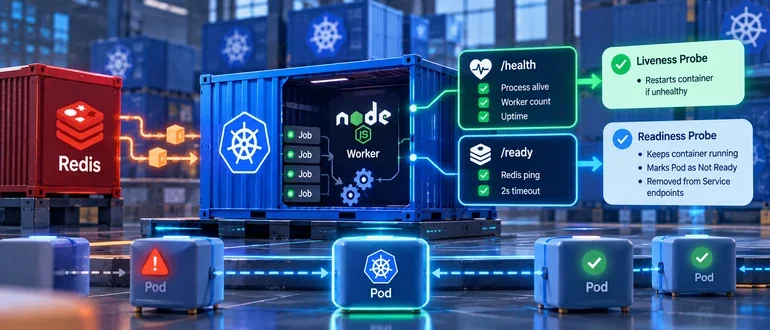
As a workaround, the team replaced the exec probe with a simple HTTP health check that verified whether the Node.js process could respond, specifically through a `/health` endpoint that mirrored the worker's operational status. This change was smart, but it avoided checking Redis directly by design. It’s more significant than it looks; not checking dependencies allows the application to continue running even if those services are down. Yet, the downside is clear: without direct checks, you risk ignoring problems that could escalate and impact your system's performance.
### The Shift to Meaningful Checks
By implementing this HTTP endpoint, the team made a significant improvement. The `/health` endpoint simply confirmed that the Node.js app could handle requests. If Redis had an issue, it wouldn’t inadvertently lead to unnecessary worker restarts because the health check wasn't tied to that dependency. In this way, the solution was safer—restarts due to Redis outages could be avoided, which is vital for maintaining stability in a production setting.
However, one can point out that the absence of checks against dependencies could also mean delayed response to critical failures, potentially resulting in longer recovery times when those systems fail. Can we afford to overlook direct dependencies in a highly interconnected ecosystem? That’s still up for debate.
On the other hand, a separate readiness probe was set up to ping Redis directly. This probe did check the status of Redis independently but cleverly indicated when the application wasn’t ready to accept new jobs by sending a `503 Service Unavailable` if it couldn’t connect to Redis. However, this is where a limitation became evident: while readiness could signal the state of the Pod, it could not control the flow of jobs into the worker. If the worker was still alive but deemed not ready, it could still pull jobs from Redis unless additional application-level logic was implemented.
### Implications and Future Outlook
What this means for you is simple: configuring Kubernetes probes isn't something to gloss over. As deployment complexity increases, the nuances of liveness and readiness probes can dictate whether your application thrives or flounders under pressure.
This case underscores the complexity involved in orchestrating services in Kubernetes. Proper configuration of liveness and readiness probes is not just about keeping containers running; it’s about ensuring those containers can interact successfully with their dependencies and handle workloads efficiently.
If you're working in this space, it’s essential to design for the realities of the application lifecycle—not just the container lifecycle. Testing your suite of probes in an environment that mirrors production, complete with all necessary utilities, can help catch these issues before they spiral into larger operational failures. This tweak helped ensure that the worker remained functional, adapting to dependency failures without triggering additional chaos in the system. Remember this: in Kubernetes, small misconfigurations can lead to enormous repercussions.
In a world where cloud-native applications are the norm, deepening understanding and refining the approach to probes could be what sets successful deployments apart from those that constantly battle instability. Keep that close to your mind.
Discussion
Sign in to join the discussion.