Bridging the Verification Gap in AI-Driven Kubernetes Management
Published
Sep 15, 2026
Desk
AI & ML
Views
1,177
AI tools in Kubernetes increase operational efficiency, but ensuring actions align with intent and verify success is crucial for reliable automation.
Understanding the Verification Gap in Kubernetes Remediation
Recent developments in AI-driven tools for cluster management have shifted the conversation in cloud operations. While the excitement around autonomous remediation platforms builds, stemming from innovations like Red Hat's upcoming Go-based Model Context Protocol (MCP) server, the real challenge is less about empowering these AI agents with write access and more about ensuring their efficacy in delivering the desired results.
Kubernetes clusters are increasingly governed by sophisticated AI models, allowing them to directly interact with and modify operational resources. This seems like a positive evolution. However, the industry is glossing over a fundamental truth: just because a tool call returns a success message doesn't guarantee the desired action actually took place or worked as intended. The risk here is substantial; without proper verification, an AI agent may incorrectly infer its action was successful based solely on the tool's feedback.
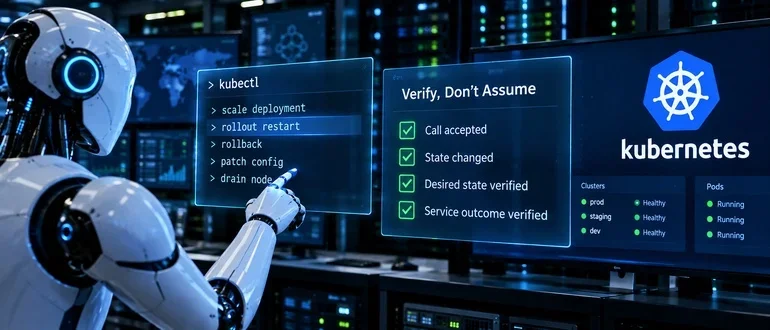
So, let’s break down what this really means for those of us in the field. Reliable autonomous operations call for a multi-faceted verification approach. No longer can we simply celebrate a successful tool call. There are critical four checkpoints to address:
1. **Call Accepted:** Did the Kubernetes control plane capture the action request? Issues like network partition can derail this process, leaving an agent in the dark about whether its command reached its destination.
2. **State Changed, Without Duplication:** Did the intended effect take place without unintentional side effects? If an operation is meant to scale up a deployment just once but fails to be idempotent, the agent may unknowingly repeat the action, leading to unintended outcomes.
3. **Desired State Verified:** Is the current state of the cluster what the agent aimed to achieve? A simple success message from a rollout command can mask deeper underlying issues if the verification isn’t carried out.
4. **Service Outcome Verified:** This final check examines whether the application has indeed recovered. We cannot overlook this; an apparent "green light" from a deployment doesn't inherently signal that your application's health has been restored.
When an agent operates based on a flawed assumption—believing it executed a successful operation without confirming the nuances—it sets a dangerous precedent. Think of a human operator who, upon receiving a successful command feedback, might feel assured about the state change. An AI agent, however, lacks the instinct to question its own interpretations or the validity of its internal model. And this gets even more complicated once we consider operational intent.
The Intent Gap: A Hidden Challenge
Even in scenarios where tool calls are verified as successful, they may not align with the operator's true intent. For instance, an agent programmed to stop a function might effectively scale down a deployment to zero, effectively resolving immediate issues but rendering the service offline. Here, the execution error lies not in the retry but in a misalignment of intentions—what the agent achieved did not fulfill the operator's real objectives.
As such, verifying outcomes demands more than just confirming that an action had the expected effect. It requires assessing whether the system has indeed moved to a state that meets the operator's goals. This introduces a need for independent health signals—metrics such as error rates or transaction latencies—which provide a more reliable gauge of system performance than mere tool-call results.
Final Thoughts on Agentic Remediation
The reality is that as we integrate AI agents more deeply into Kubernetes operations, the stakes get significantly higher. While agentic remediation has the potential to revolutionize cloud operations, the verification challenges pose a real risk if left unaddressed.
Before placing your trust in these sophisticated tools, ensure that they don’t just claim success but can substantiate their operations with rigorous checks. Be prudent; effective recovery and remediation depend on a solid verification framework.
It’s a complex puzzle we’re yet to solve, but it’s imperative we navigate these intricacies before handing over the reins to AI. The tools might be ready, but the verification strategies are what will ultimately determine their success or failure.
The Path Ahead for Kubernetes and Agentic AI Solutions
The conversation around Kubernetes management, particularly with AI involvement, is just beginning. It’s easy to overlook the nuances when we get excited about technological advancements. Sure, an AI tool may effectively communicate with Kubernetes, but that’s only part of the equation. Here’s the reality: a tool signaling success doesn’t guarantee that any desired state was actually achieved. You can’t solely rely on that success indicator—this can lead teams into a false sense of security.
This raises a more pertinent issue: verification. Postcondition verification isn’t just a technical add-on; it’s an essential strategy in this context. After any operation, teams need to reassess the cluster to ensure that it has transitioned to the intended state rather than accepting the original command’s outcome as gospel. If you’re in a role that oversees AI-dependent systems, you must evaluate whether your protocols include robust postcondition checks.
Moreover, organizations need to establish a set of requirements before letting AI agents directly intervene in production Kubernetes environments. This involves not just requesting durable operation identifiers but also instituting independent health checks, transparency around ambiguous outcomes, and heightened observability to trace back any issues to the agent's actions. Team readiness for these responsibilities cannot be overstated; ambiguity could lead to significant setbacks.
While the horizon is promising with AI stepping into Kubernetes management roles, the challenges are equally daunting. The ongoing developments in this space demand prudent implementation, sharp oversight, and a commitment to verification. As you navigate this complex terrain, remember that proactive measures today will streamline your operations tomorrow. It’s all about making informed decisions that minimize risk while maximizing efficiency. If you’re gearing up to integrate AI into your Kubernetes strategy, ensure verification isn’t just an afterthought—make it a core principle.
Discussion
Sign in to join the discussion.