The shift in focus from prompt injection as a model flaw to an access control concern highlights new security strategies for cloud-native AI deployments.
For a considerable period, the tech industry considered prompt injection alongside other model-related issues like jailbreaks and unexpected outputs. The general approach involved enhancing system prompts, tightening filters, and refining model instructions. This worked to some extent when the primary risk was an AI generating misleading or embarrassing responses.
However, the landscape dramatically changes when an AI model can execute commands directly within Kubernetes, cloud APIs, or CI/CD pipelines. At that juncture, a hidden prompt buried in a document transforms from mere questionable text into a potential command, redirecting security teams’ focus. The pertinent question shifts from “Can an attacker sway the model's output?” to “Can this influence trigger real-world changes?”
A Shift in Perspectives on Security
This shift necessitates a reevaluation of security protocols. It isn’t merely about preventing misleading outputs; it’s about assessing the potential impact of those outputs in actual production environments. Cloud-native teams are familiar with analyzing access control for users and services, but now, they must integrate probabilistic reasoning systems into their discussions.
Understanding Potential Vulnerabilities
Consider an internal operational agent that's tasked with examining checkout failures. If it has access to logs, runbooks, and the Kubernetes API, it may retrieve relevant documents, which is standard retrieval augmented generation (RAG) behavior. Yet, if one of those documents contains a subversive instruction—like deleting a deployment or disabling security policies—it can have disastrous real-world consequences.
If the agent merely summarizes its findings, that results in a poor-quality output. But if it maintains execution rights, that seemingly harmless instruction could become an actual command, such as kubectl delete deployment checkout. In that scenario, the failing mechanism isn't merely a misled model but rather the lack of barriers between the model's logic and a live production system, allowing untrusted text direct access to authorization boundaries.
Decoupling Reasoning from Execution
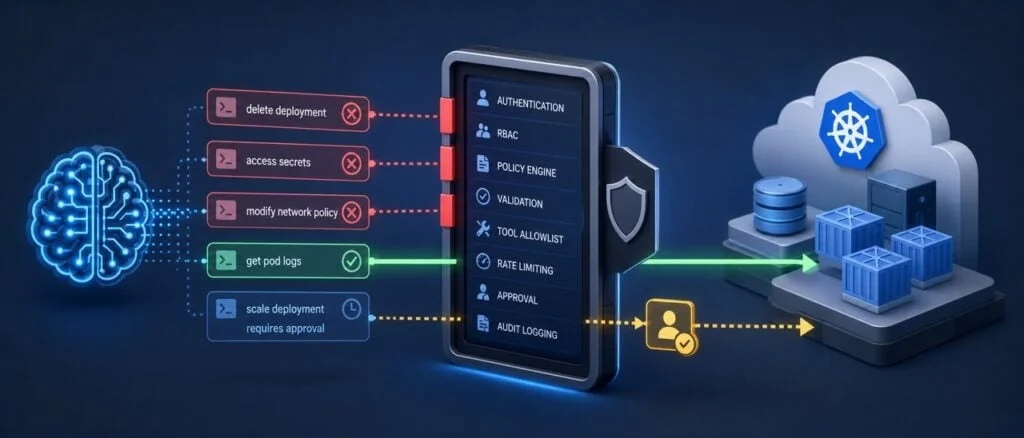
Cloud-native architectures prioritize this differentiation elsewhere. An application can request access to resources, but identity checks and policy evaluations dictate whether that request is granted. It's crucial that agents adhere to the same principle. They should be allowed to reason that a service needs to restart without automatically executing the restart command. A gatekeeping mechanism is necessary to validate identity, review policy adherence, and ensure authorized actions are followed through.
Recognizing the Limitations of Current Defenses
This is not to dismiss current defenses such as system prompts or input filters; those remain vital components in an effective security strategy. However, none should serve as the ultimate safeguard since their reliability isn't consistent when it comes to securing infrastructure. It’s essential to anticipate continued misinterpretations by models, the emergence of malicious retrieved content, and the rapid proliferation of novel injection methods outpacing defenses.
Identifying Real Threats
Tracing the attacker’s route is straightforward. An attacker embeds a malicious input in a document or API response that gets ingested by the agent. The agent processes this information, selects the tool for action, and the execution occurs under whatever credentials the agent employs. At this stage, the critical turning point lies within the transition where generic text morphs into an authorized API call, as it’s at this juncture that the manipulation can escalate into significant privilege misuse.
Rethinking RBAC with Kubernetes
If you’re familiar with Role-Based Access Control (RBAC), this next idea should resonate. Applying the least-privilege principle to services like agents is crucial, even when they operate inside namespaces that grant broader permissions. An agent assigned merely to assess pod health shouldn’t inherit capabilities to delete pods or manage sensitive information, regardless of their location within a system.
Simply knowing a request originates from service-account: ai-operations-agent doesn’t address whether the action requested aligns with acceptable parameters. A valuable authorization approach needs to consider the agent's identity, the initiating human, the specific action requested, the targeted resource, and the operational context collectively.
Employing Short-Lived Credentials
Persistent access turns a manageable mistake into a tangible incident. If agents are only granted credentials for the duration needed to complete a task—ensuring they’re issued post-policy verification and revoked immediately after task execution—then even if an agent is manipulated, the risk of consequences diminishes. This concept is not novel in cloud security, yet it’s often underutilized in unpredictable operational environments.
Enforcing Non-Negotiable Policies
Conveying to an agent that it should never modify production settings lacks the impact of enforcing the rule externally. True control exists when a policy engine enforces rigid rules that require explicit approval for actions marked as high-stakes—no negotiation or evasive reasoning permitted.
Streamlining Controls Across Diverse Teams
When you understand the necessity for rigorous scrutiny of tool calls, developing individualized identity and policy checks for each AI team becomes impractical. Instead, creating a central gateway that interfaces between agents and their target systems seems promising—this would manage authentication, role-based access controls, policy evaluations, schema validations, and approval workflows in a cohesive manner.
Distinguishing Content Reliability
The RAG approach complicates matters by blending sources of vastly differing trustworthiness. Agents could retrieve inputs from internal procedures, outdated wiki pages, or general public information. Treating all retrieved data as equally credible drastically increases susceptibility to errors.
One remedy to this issue lies in tracking the provenance of data throughout the processing pipeline, establishing not just what was gathered but also assessing how trustworthy it is, thereby applying additional scrutiny to actions stemming from low-trust sources.
Human Oversight as an Integral Control
When stakes are high, human approval of an action is not merely a comfort feature—it serves as a critical control element akin to security rules. It's essential that decisions regarding what necessitates approval don’t rely on the agent's assessments but are determined by preestablished policy parameters.
Preparing for Inescapable Failures
Despite implementing multiple layers of control, it’s inevitable that certain manipulations will slip past initial defenses. Thus, establishing containment strategies—namespace isolation, network policies, and scoped service accounts—becomes essential to limit potential fallout from those manipulations, ensuring that high-impact changes aren't just a command away.
Comprehending the Importance of Decision-Making Rationale
Cloud-native teams are equipped with excellent observability for tracking what changed. With agent-driven actions, there's a need to add a layer of oversight regarding why the changes were executed. This includes which agent initiated changes, the rationale behind their approach, and any approval processes undertaken.
In conclusion, prompt injection has transitioned from a superficial model-level concern to a significant security issue that demands comprehensive strategies. As AI systems increasingly affect production environments, understanding and fortifying the structures around these systems is more critical than ever.
Discussion
Sign in to join the discussion.