Modernizing legacy systems for real-time AI requires an architectural overhaul to ensure responsiveness and adaptability in digital environments.
As organizations increasingly pivot to artificial intelligence, the expectations surrounding software platforms have shifted dramatically. Systems that traditionally handled transaction processing in batches are now required to respond to events almost instantaneously. The challenge often lies not in the models being designed but in the platforms that support them.
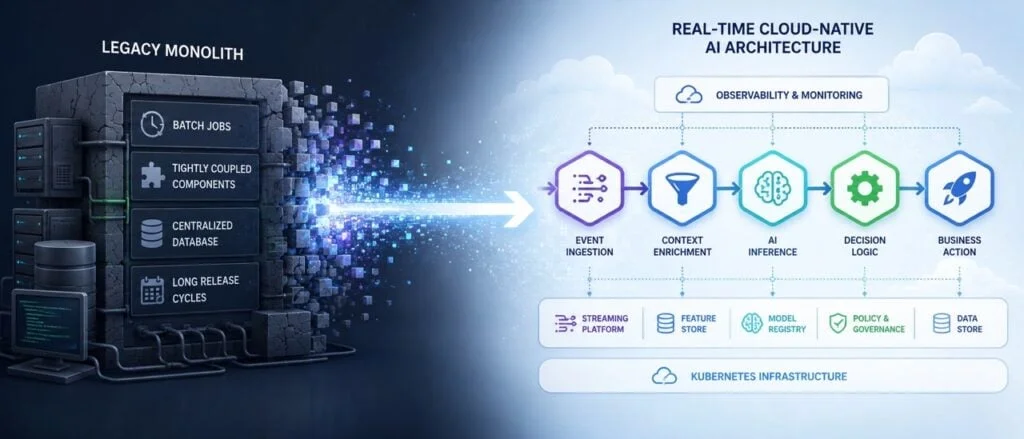
A significant number of legacy applications were built around concepts like scheduled jobs, tight coupling between components, centralized databases, and lengthy release cycles. While merely migrating these applications to cloud environments can enhance infrastructure flexibility, it doesn't necessarily deliver the agility required for real-time AI applications. A strategic transition to cloud-native solutions involves a fundamental architectural transformation.
Transitioning to Event-Driven Architectures
Batch processing still has its place within certain workflows that don't demand immediate action. However, modern AI applications typically hinge on an event-driven approach. This method allows for services to publish relevant changes while enabling downstream components to subscribe to necessary events. A basic flow for real-time decision-making could look like this:
Event → Context Enrichment → AI Inference → Decision Logic → Business Action
This structure minimizes excessive polling and supports independent scalability among components. Nevertheless, moving to a message broker is merely the beginning. Clear event ownership, governance of event schemas, replay strategies, idempotency measures, and error management must also be well-defined.
Decoupling AI Inference from Application Logic
Embedding machine learning models directly into applications might suffice for pilot projects, but as these models evolve, such structures can lead to complications. Teams may often need to retrain models, compare different versions, conduct canary releases, or carry out swift rollbacks.
By treating inference as a standalone service, you can create a clear boundary between the application and the model. This enables applications to interact with a stable API or publish events without direct dependency on internal model workings. The advantages of this separation include independent scaling, model version management, controlled deployments, and operational flexibility.
Prioritizing Context Over Speed
While rapid predictions are essential, relying on outdated context leads to poor decision-making. Real-time AI should involve a comprehensive context built upon historical data, current user behaviors, recent transactions, device metrics, eligibility rules, and prevailing operational parameters. Cloud-native architectures typically leverage streaming technologies, low-latency data storage solutions, caches, and feature services to gather this vital context.
The ultimate aim shouldn't be to make every dataset real-time; rather, it should focus on identifying critical data points that inform immediate decisions while being mindful of practical latency needs.
Strategic Decomposition of Systems
Microservices can offer distinct ownership and deployment boundaries when approached thoughtfully. Conversely, fragmentation for its own sake can yield diminishing returns. Transmuting a single monolithic system into numerous microservices might introduce network delays, diverse failure patterns, and complications with observability.
For a real-time AI framework, it’s beneficial to draw meaningful boundaries around capabilities like event ingestion, context enhancement, inference, decision-making, orchestration, and data delivery. This configuration allows for independent evolution while minimizing unnecessary interdependencies.
Kubernetes as a Core Infrastructure
Kubernetes brings a suite of invaluable features—workload orchestration, horizontal scaling, service discovery, health checks, and rolling updates. These functionalities prove especially beneficial when handling AI workloads with varying resource needs. However, it's crucial to remember that Kubernetes itself is not an architectural solution. Simply containerizing suboptimal applications does not render them cloud-native.
Applications still need to define appropriate service boundaries, utilize asynchronous communication when beneficial, automate deployments, and ensure resilience and observability. Kubernetes should enhance these engineering choices rather than replace them.
Embracing Failure in Design
In distributed systems, it's vital to adopt a mindset that anticipates failures. Components might fail, network calls could time out, events may duplicate, or downstream services may go offline. Incorporating design principles like timeouts, backoff retries, circuit breakers, idempotency, and dead-letter processing into the architecture is essential. For critical functionalities, multi-zone or multi-region deployments may also be warranted.
Reliability metrics should encompass the entire business flow, moving beyond the model endpoint.
Integrating Observability in the Architecture
Real-time AI requests typically traverse multiple points in a system, including API gateways, event platforms, enrichment services, feature stores, inference engines, decision processors, and final applications. Without thorough observability, pinpointing latency issues or incorrect behaviors becomes increasingly challenging.
Establishing monitoring for metrics, logs, and distributed traces should be a foundational element of system design. AI applications introduce additional metrics such as model latency, prediction distributions, feature availability, and decision outcomes, necessitating comprehensive visibility that covers both application and model behavior.
Governance in Runtime Architecture
As AI integrates more deeply into operational workflows, documentation alone won't suffice for governance. The architecture must enable traceability at runtime. Teams should be capable of identifying which model version contributed to a decision, what data was utilized, and the ensuing actions taken. Employing model registries, version-controlled configurations, audit trails, and decision logs can aid in establishing this traceability.
Incremental Modernization Strategies
For many organizations, a complete system overhaul isn't feasible. A more practical approach involves gradually modernizing legacy systems. By exposing existing functionalities through APIs, publishing critical business events, and introducing new cloud-native services around current applications, companies can transition smoothly. Over time, individual features shift to a modern platform while phasing out older components.
This gradual transition allows businesses to integrate real-time capabilities and AI functionalities without necessitating major disruptions.
The essence of an effective cloud-native AI platform lies not in a particular model or framework but in its ability to adapt—characterized by loosely coupled services, event-driven communication, robust computing architecture, low-latency data access, automated deployments, resilience, observability, and integrated governance. The more pressing question for modernization isn’t simply, "How do we migrate this application to the cloud?" but rather, "How should this system perform when real-time decision-making becomes fundamental?" Answering this will guide deeper, meaningful transformations that are essential for modern enterprises.
Discussion
Sign in to join the discussion.