Enhancing Application Efficiency with Consul 1.22's Multi-Port Service Discovery
Published
Jul 22, 2026
Desk
Development
Views
471
Consul 1.22 simplifies service discovery by allowing multi-port registration, streamlining operations and improving application performance.
The Shift Towards Multi-Port Service Discovery
Modern applications don’t just rely on a single port; instead, they often use a variety of them. A single service can communicate API traffic through one port, output metrics via another, and manage admin tasks on yet another. Historically, service discovery hadn't quite caught up to this level of complexity—until now.
Consul, the service mesh and service discovery tool, has unveiled a refined model in its latest iteration that aligns service discovery with contemporary application design. With Consul 1.22, developers can register services with multiple named ports, effectively simplifying the service catalog. This addition marks a significant improvement, enabling teams to register one service with distinct identifiers for each port and discover the specific port they need.
Here's the thing: the historical workaround involved creating separate service entries for each functionality—think `order-http`, `order-admin`, `order-metrics`, and potentially more. While this approach worked, it excessively complicated operations.
- Health checks and observability had to be fragmented across these multiple service entries.
- Policies had to cater to several service names instead of a unified identity.
- Dashboards and operational playbooks often required extra effort to piece together a coherent view of the actual application.
- Even Kubernetes service registrations didn’t easily correspond with Consul entries.
With Consul's native multi-port support, users can model their applications as they're intended to operate. The service retains a single identity, while each port can be explicitly named. This not only eliminates clutter in the service catalog but also streamlines various operational aspects.
A New Approach to Service Discovery
In Consul 1.22, the introduction of multi-port registration lets a service maintain a comprehensive list of named ports. Take a look at a sample HCL configuration for clarity:
```hcl
service {
name = "order-service"
id = "order-service-1"
address = "10.42.0.25"
tags = [
"team:payments",
"env:prod"
]
ports = [
{
name = "http"
port = 8080
default = true
},
{
name = "admin"
port = 9090
},
{
name = "metrics"
port = 9100
}
]
checks = [
{
id = "order-service-http"
name = "HTTP health"
http = "http://10.42.0.25:8080/health"
interval = "10s"
timeout = "2s"
}
]
}
```
This setup not only maintains backward compatibility for existing clients—which still communicate through the default port—but also introduces flexibility for newer clients that can now request specific ports to suit their needs.
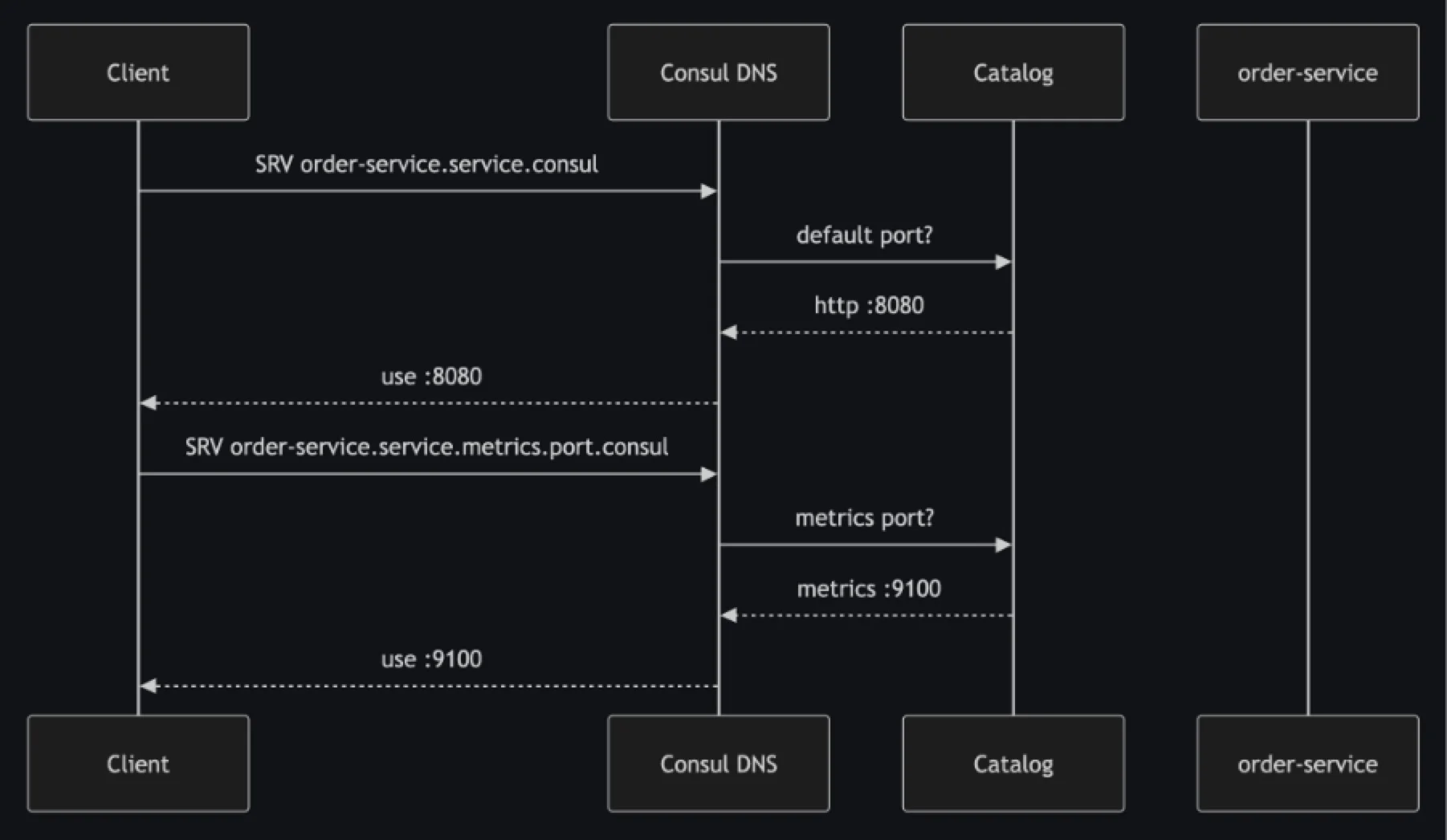
Using Consul's DNS service, developers can easily resolve the default and specific service ports, giving clients clear pathways to access the services they require. For instance, using `dig` commands, they can query both the default port and additional ports without any confusion—a marked improvement in service accessibility.
Seamless Integration with Kubernetes
The integration with Kubernetes is particularly noteworthy. Kubernetes services are already designed with named ports, making it straightforward for Consul to synchronize and reflect these named ports in its catalog. This means that when Consul registers a service from Kubernetes that has multiple ports, it maintains a single service representation complete with designated port names, allowing for a cleaner and more intuitive mapping back to the original deployment.
The multi-port capability even extends to health checks and service addressing, ensuring that existing systems and practices remain intact while introducing the efficiency of named port discovery. Operators can expect a smoother experience without compromising the predictability of operations across different environments.
In essence, this shift in how services can be registered and discovered in Consul not only simplifies management but also aligns closely with current practices in software architecture, offering a pragmatic approach for teams navigating complex service ecosystems.
Final Thoughts on Multi-Port Support
As the tech landscape evolves, so too does the need for infrastructure solutions that keep pace with application requirements. The introduction of native multi-port services in Consul is more than just a minor adjustment; it addresses a crucial gap between how applications function and how they've been previously represented in service discovery systems. This shift allows for a single application to maintain just one Consul service identity, which simplifies the interface and enhances clarity.
What’s especially telling about this transition is how it reflects broader operational needs. Instead of forcing teams to adapt workflows around a predefined, inflexible model, this approach encourages a more organic alignment of services with the actual architecture of applications. DNS can now resolve the specific port a client requires, making interactions smoother and more efficient.
Looking Ahead
Looking ahead, the roadmap for Consul indicates exciting developments. The ability to route multi-port traffic through a sidecar enhances efficiency while keeping compatibility with existing systems that expect a default port. Furthermore, the expansion into Kubernetes service ports demonstrates an awareness of contemporary operational practices.
This isn’t just a tick on a checklist; it’s about effectiveness and maintaining coherence within a wide ecosystem. As we anticipate native multi-port support integrating into features like API gateways and health checks, the expectation is clear: provide operators with the granularity they need without sacrificing the overarching simplicity of service management.
Ultimately, this change isn’t just a technical necessity; it’s a pathway toward more intuitive and manageable service architecture. For teams working in this space, adapting to multi-port models will likely streamline operations, reduce redundancies, and offer a more cohesive view of service health and routing. This is a step in the right direction, reshaping how organizations interact with their infrastructure. It's clear: change isn't just possible—it's already underway.
Discussion
Sign in to join the discussion.