AI-Driven Innovations in Infrastructure Management: Enhancing Efficiency and Automation
Published
Aug 05, 2026
Desk
AI & ML
Views
475
AI is transforming infrastructure management by automating complex tasks, enabling rapid execution, and shifting focus from coding to verification and policy governance.
AI influences on infrastructure management extend far beyond the initial setup of configurations; it's about rethinking workflows throughout the entire lifecycle of applications. From developers constructing infrastructure with simple, approved patterns to platform teams developing modules based on compliance criteria, AI is reshaping how we interact with technology. This includes everything from executing complex operations on Day 2—such as managing drift and version upgrades—to enhancing policy generation through the use of APIs.
The real revelation here is that AI alters the location of limitations in the process. Previously, tasks requiring variable coding might take days to complete, but now they can often be done in mere seconds. This leap in efficiency shifts the bottleneck from coding to verification and approval. The implications for platform engineers are significant: they should allocate less of their time to writing configurations and more to architecting processes, defining specifications, and establishing verification criteria that must be passed by AI-generated outputs.
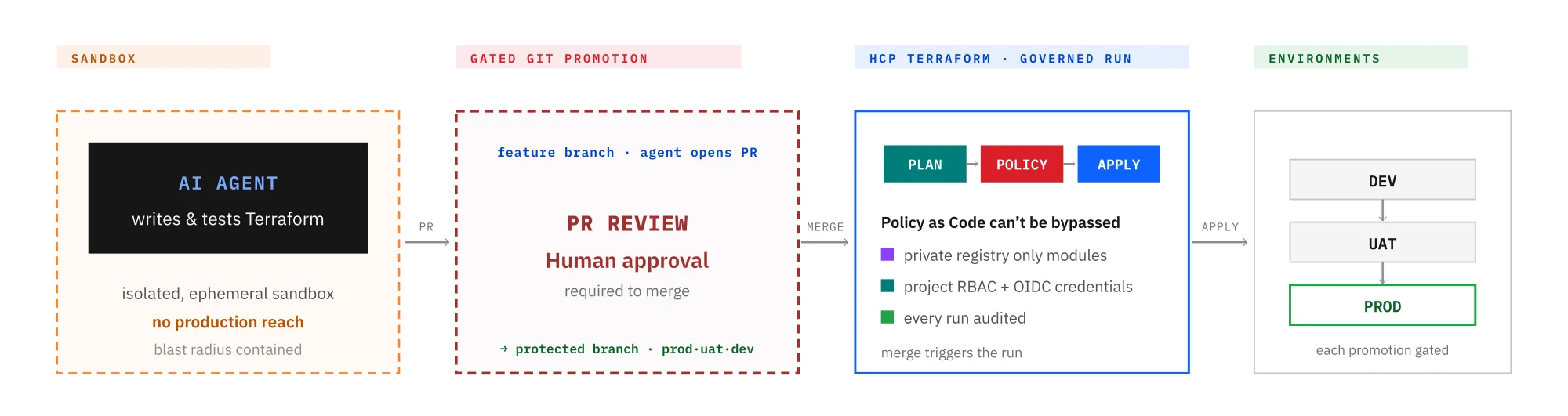
Moreover, AI agents have transformed the operational loop that was once wholly human-driven. Now, they autonomously script Terraform code, implement changes, and initiate executions, all without human involvement at each step. This automation is governed by the HCP Terraform control plane, which not only manages the output from these agents but also enforces policy checks before any changes can occur. As a result, the existing need for stringent controls is heightened, not diminished, by the reliance on AI. The quality of the control plane is directly linked to how well teams configure their boundaries—this encompasses everything from approved modules to scoped identities and detailed run histories that serve as evidence.
In the upcoming sections, we'll unravel why the rise of these autonomous agents challenges foundational assumptions about Infrastructure as Code (IaC) reviews. We'll explore the multifaceted defenses that HCP Terraform employs to interpose between agent outputs and production, how these safeguards integrate from development through to the cloud, and the evolving operational model that allows for a gradual increase in agent autonomy, rather than a reduction.
Automation Risks: Beyond Terraform
It's critical to understand that the primary risk lies not within Terraform itself, but rather in automation efforts lacking adequate oversight. AI coding agents have progressed significantly beyond simple code completion, now capable of executing a repeatable loop of planning, executing, observing, reflecting, and restarting—all at a speed beyond human capacity. This operational mindset was initially structured for human authors, where casual reviews and policy adherence were determined on an individual basis. Enter the autonomous loop, which subverts all of these traditional paradigms simultaneously. It doesn't experience fatigue, and the concept of time means little to its operations. Should an AI agent have write access without sufficient controls in place, it could amplify existing vulnerabilities in your Infrastructure as Code practices, resulting in inaccuracies, unregulated changes, unnecessarily broad access rights, and potentially devastating consequences.
This isn’t a cry for entirely new tooling or an invitation for engineers to micromanage every automated run. Rather, the solution lies in ensuring that every action taken by an AI agent traverses the same controlled pathways that human authors would typically follow. The agent's role should be to suggest changes, not decide on execution without oversight.
Multi-Layered Defense Strategies
To navigate the complexities of autonomous operations seamlessly while upholding necessary production controls, organizations must ensure all agent-generated changes pass through a managed control plane. HCP Terraform establishes a comprehensive governance model, embedding multiple layers of defense. Each of these layers serves as a controlled feature of the platform, further securing operations against the disarray an unguided loop might bring.
Provenance, for instance, provides a grounding in authoritative data sources, incorporating approved Private Registry modules and organizational standards, ensuring all AI decisions rest on solid foundations. Complementary mechanisms like policy as code evaluate every execution before application, safeguarding against unreviewed changes. Additionally, identities are kept dynamic and project-specific, meaning access credentials are issued and revoked appropriately, minimizing risk. It's sophisticated measures like these—combined with safeguarded projects and detailed execution histories—that create a comprehensive security posture.
In summary, enabling AI to function autonomously in infrastructure management isn't about granting carte blanche freedom. It's about integrating strong, layered governance that ensures the efficiency of AI operations complements the controlled environment necessary for modern infrastructure management.
The Risks of Unregulated Agent Actions
When agents operate without established modules, skill sets, or standards guiding their actions, they inevitably resort to generalized assumptions. This reliance on broad priors can lead to the construction of infrastructure that, while appearing plausible, lacks rigorous testing and validation. In essence, agents become architects of unverified systems, which could expose organizations to unforeseen vulnerabilities and risks.
The situation is exacerbated further by the thin layer of policy oversight that exists in these environments. In theory, policies should evaluate every action taken by the agent; however, without a robust approval mechanism, there’s a significant risk that security and compliance checks fall by the wayside. Instead of adhering to policy-driven decision-making, an agent's confidence often dictates which changes go live. This scenario can turn into a ticking time bomb where unchecked confidence leads to dangerous missteps.
Identity management is another critical area that complicates this landscape. Agents typically possess long-lasting access rights and expansive secret management that can extend across various environments. This creates a nightmare scenario; once an agent is compromised, the breach can cascade across numerous systems, putting the entire organization at risk.
Isolation should be a fundamental principle in any environment utilizing agents. The absence of clearly defined project boundaries means that a misconfiguration or an erroneous action by an agent can have a ripple effect, jeopardizing every project it touches. This raises an urgent question: how can teams ensure that their infrastructure remains secure when the very mechanisms designed to manage it can become points of failure?
Moreover, the lack of audit trails means that when something goes wrong, teams face an uphill battle trying to trace the source of issues. If no enduring record exists of what changes were approved or what policies were bypassed, reconstructing the chain of events becomes nearly impossible. In a world where every decision can impact significant operations, this broken feedback loop poses monumental risks.
Final Thoughts: Redefining Automation with Control
The evolving approach to cloud infrastructure automation highlights the critical balance between efficiency and security. Organizations are moving away from traditional models where human oversight is required for every change. Instead, they're adopting architectures where an agent operates under a project-specific identity, limiting human access and potential errors.
A key takeaway is the project-level role-based access control (RBAC) that now relies on dedicated tokens for teams. This shifts the operational risk from human errors to a more controlled environment where dynamic provider credentials are short-lived and revoked after each run. While this may appear standard, it actually indicates a significant move towards heightened security measures that reduce exposure to sensitive cloud secrets.
Moreover, containment strategies are embedded within the architecture. When something goes wrong, the system is engineered to cap the impact, enforcing isolation that prevents cross-project disturbances. With each Terraform project confined to its cloud sub-account and managed through strict authentication processes, the risk of one environment corrupting another diminishes substantially. The directive here is clear: security is no longer a bolt-on; it must be integral to the design.
However, questions linger. Is the complete autonomy awarded to agents without human oversight a double-edged sword? As they propose and manage changes autonomously, there remains a risk that they could inadvertently introduce errors undetected by their own checks. It’s essential to maintain robust verification processes separate from the agent’s operations to ensure integrity in deployments.
For professionals navigating this landscape, understanding these dynamics is essential. The shift toward controlled environments not only enhances operational agility but also demands a reevaluation of how teams collaborate within the confines of these systems. Ultimately, as organizations lean more on automation, striking the right balance between agent independence and stringent checks will define success in the rapidly changing cloud ecosystem.
Discussion
Sign in to join the discussion.