Enhancing Kubernetes Deployment Reliability with Automated Validation
Published
Aug 13, 2026
Desk
AI & ML
Views
840
Overcome the gap between deployment success and application health in Kubernetes by automating validation, reducing checks from 45 minutes to 2 minutes.
Bridging the Deployment Reliability Gap
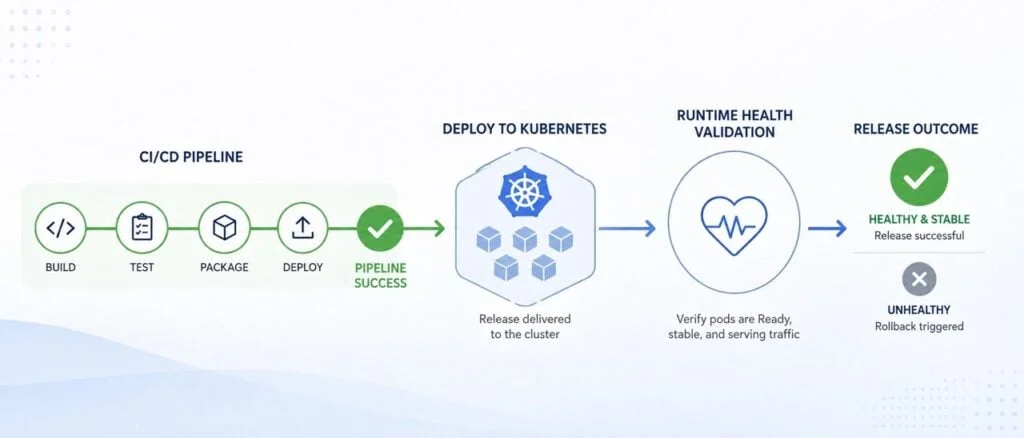
Getting a CI/CD pipeline to turn green is a common sigh of relief for any release engineer. You know the feeling: the deployment job succeeds, and there's a momentary belief that everything is in order. However, in the Kubernetes world, this assumption can be misleading. Just because the deployment step completed successfully doesn’t guarantee that the application is fit for service.
For teams managing Kubernetes workloads—particularly in high-stakes environments like payments—the distinction between deployment completion and application health is pivotal. The former merely indicates that code was pushed out; the latter addresses whether users can access the application's functionalities. This oversight creates unnecessary pressure and anxiety among engineers, resulting in procedural inefficiencies and a gap in reliable verification.
Recognizing this dilemma, our team set out to transform the manual validation process into seamless automation, slashing validation times from about 45 minutes to just 2 minutes. While the speed improvement was beneficial, the real victory lay in enhancing consistency, boosting confidence in the release process, and minimizing the operational grind that comes with manual checks.
Understanding Deployment Signals
There's a critical difference between deployment completion and application health that teams working with Kubernetes must grasp. Deployment completion signifies that the code has been delivered successfully, but it raises further questions: Did the pods initialize correctly? Are they ready to handle traffic? Are there any backend issues yet to be addressed?
The alarming reality is that a deployment may conclude while underlying issues persist; pods could fail readiness checks, or certain services might crash upon initialization. Those working within CI/CD systems often overlook these subtleties, leading to degraded service experiences for users.
We aimed to eliminate this reliability gap by ensuring that our pipeline not only pushed out releases but also confirmed their operational soundness before considering them a success.
Transforming Manual Workflows
Prior to implementing automation, validating a release was a tiresome manual process. Engineers were required to traverse each Kubernetes cluster and namespace, scaling deployments, checking pod statuses, and reviewing logs, all while contending with the pressure of tight release schedules. Tasks that seemed straightforward when isolated quickly multiplied into an overwhelming checklist when dealing with multiple clusters and namespaces. This repetitive toil became unsustainable, particularly for larger production releases.
Our objective was straightforward: Could we automate the checks that engineers found reliable? By leveraging our existing CI/CD framework—without overhauling it—we developed a solution that not only enhanced efficiency but also elevated the overall reliability of the release process.
Rethinking Application Readiness
A vital component of our automated checks focused on pod readiness. In Kubernetes, "Running" and "Ready" are not synonymous. Just because a pod is running doesn’t mean it’s prepared to serve traffic. We needed to ensure that not only were pods running, but they were also capable of handling user requests.
The new automation evaluates the health of pods after deployment, not just their operational status. By thoroughly checking both readiness and failure reasons, we significantly reduced the time required for engineers to address issues should a release fail.
Introducing the 60-Second Stability Window
One notable design feature that increased the reliability of our validation process was the implementation of a 60-second stability window. Initially, we considered marking a release as successful as soon as all pods achieved a "Ready" status. However, this approach could lead to hasty conclusions, as a pod might briefly become "Ready" only to encounter issues moments later.
With the 60-second stability check, we ensure that all pods remain healthy over a minute following their readiness. In the event of any health discrepancies, the pipeline resets its assessment timeline, providing a more reliable indication of stability. This amendment alters our definition of a successful release: rather than simply marking it as healthy at a moment in time, we confirm sustained health over a verification period.
Outcomes of Our Automation Journey
Post-automation, we realized tangible benefits. Validation has been sped up dramatically, and more importantly, our process is far more consistent. Each release now follows an established path, systematically checking requirements without the risk of human error or oversight.
Confidence in the release process has risen as well; no longer do engineers have the sole burden of manual confirmation. This newfound automation ensures better checks and balances around application health, affirming that the real measure of a successful deployment isn’t just about pushing code but ensuring the application functions reliably once it's out there.
In a nutshell, we discovered that the path to more dependable releases doesn’t necessitate complex systems or heavy new platforms. Rather, start with the manual checks your team already trusts, automate them within your existing framework, and firm up protocols for validating health before claiming a release as complete. This approach not only hones the deployment process but builds a more reliable operational environment for all.
Discussion
Sign in to join the discussion.